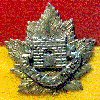
The text below is taken from the book All
Tanked Up written by John Owen Smith from interviews with villagers of Headley
and Canadian veterans who remembered the 'benevolent occupation' of the Canadian
troops during the Second World War.
The largest body of troops to sail from Canada during the war embarked at
Halifax in November 1941, and included the 5th Canadian Armoured Division.
The convoy of 12 liners arrived on this side of the Atlantic on 22nd/23rd
November.
On landing in Britain, the regiments were first sent by rail to
Aldershot, and Pete Friesen of the Fort Garry Horse remembers marching from
Aldershot station through the town at midnight to full musical
accompaniment from their trumpeters, of whom he was one – and being
booed by the residents for waking them!
After a few weeks, the regiments were moved to other locations more suitable
for tank training. One of these was Headley.
This was April 1942, a time of many Canadian arrivals in the area.
During the month, men from armoured regiments marched or drove along the
lanes from Aldershot, including the Fort Garry Horse, who were
to become the best known regiment in the village, as they and their mascot
'Whitey'
were stationed here not once, but twice during the run up to D-Day.
On arrival, the troops were delighted to find that the new billets were
vastly more pleasant than the damp, dark barracks of Aldershot.
The Garrys' official record states that Headley "proved to be one of our most
popular stations; we soon got to know the natives, who we found very
agreeable – it was really our first meet up with the English folk."
Each regiment had a compliment of 660 'all ranks', and at least two
regiments at a time were stationed here, so accommodation for more than
1,300 men must have been required in and around the village. They were
also to live in Squadron groups (of about 80 to 90 men) for the
first time.
There were normally three regiments attached to an armoured Division or
Brigade, and these tended to move station together.
In the case of the 5th Canadian Armoured Division, two regiments
(Fort Garry Horse and Lord Strathcona's Horse) were placed in the Headley
area, while the third (1st Hussars) was placed in the Elstead area.
This continued to be the pattern for future postings here.
But where was the armour?
The Straths had only a "few old Lees and a couple of
Rams which had just arrived in the third week of March", and the Garrys had
"very few tanks" then, according to Harvey Williamson.
The full complement for a regiment at the time was supposed to be in the
region of 50-60 tanks, and these were eventually delivered in batches over
the next few years as the regiments moved around Britain from location to
location. In April 1942, however, the tank regiments had arrived, but
effectively they had no tanks.
Individual regiments were inspected during their time here by a number of
dignitaries and various Generals, but in April 1942 the 5th Canadian
Armoured Division as a whole was inspected by the King and Queen on
Frensham Common.
Pete Friesen of the Garrys has a picture from a Canadian newspaper
showing him with his kit laid out for in-spection just prior to the visit.
He remembers thinking that the King looked very ill and white –
'not real'.
In December 1942, a decision was made to reorganize the Canadian armoured
regiments in preparation for specific roles in Normandy and elsewhere.
The Garrys were now destined to play an infantry support role in the D-Day
landings on 'Juno' beach, forming the 3rd Canadian Tank Brigade
(subsequently re-named 2nd Canadian Armoured Brigade) along with the
1st Canadian Hussars and Sherbrooke Fusiliers.
The immediate effect of this, as far as the village was concerned, was to
bring the Garrys back for their second visit to Headley (and the 1st Hussars
back to Elstead).
So in February 1943, the newly formed 3rd Canadian Army Tank Brigade arrived,
but consisting largely of familiar faces: the Garrys were back in
Headley.
The regiment stayed for 3 months until the end of May 1943 and, although with
all the 'schemes' that were going on they probably lived in the area for
only about half that period, many old friendships were re-kindled during
this time!
It is perhaps some measure of the popularity of the Canadian troops in
Britain that, at the end of hostilities, there were over 40,000 brides
and 20,000 children waiting to be shipped to Canada to meet up with their
Canadian husbands and fathers.
Pete Friesen of the Garrys stayed on to help with the Canadian Wives' Bureau
in London where they took 800 girls at a time into the Portman Hotel (there
were also two other hotels) for one night before sending them by boat train
to Southampton.
Pete himself married Enid, an English girl; his younger brother Dave married
Betty, a Scottish girl; and his elder brother Jack ('Shorty') married Joan,
a Welsh girl. Veterans of the Fort Garry Horse Regiment contributing to this book
were:—
E C (Ted) Brumwell
Pete Friesen
Erle Kitching
Harvey Theobald
Rod Waples
Tom Webb
Charles Wendover
John Whitton (also of the Calgary Regt.)
Harvey Williamson
For further information on the Fort Garry Horse Regiment, visit their websiteAll Tanked Up . . . by John
Owen Smith
Large-format pages – 98pp, photos, maps, information – ISBN 978-1-873855-54-6