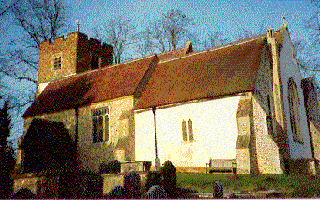
From — Some Ancient Churches in North East Hampshire
The church of St Mary the Virgin was built to serve the small hamlet which
developed beside the ancient track connecting the Celtic strongholds in the
west with the coast in the east. Later the track became the Pilgrims Way
between Canterbury and Winchester, later still to be known as the London to
Winchester Turnpike, and now as the A31.
Bentley's church, and possibly an earlier predecessor, was built on rising
ground a few hundred yards north of the present Farnham to Alton road. It
is approached through a short avenue of yew trees, which are very large and
believed to be some 600 years old. Their branches spread out over 60 feet
and have to be propped up to allow a passage through the avenue.
The original Norman church, now forming the chancel, was built in the 11th
century. The north chapel was added in 1200, being separated from the
chancel by two Norman arches, to be followed in the late 13th century by
the south chapel. These chapels are separated from the chancel by two bays.
The nave is pre-15th century, though with a roof of c.1400 when the chancel
was also reroofed and given a large east window and clerestory windows.
The nave was extended with a south aisle in the 1830s, and a north aisle at
the general restoration of Henry Woodger in 1888-9. The belfry stage of the
tower, in diapered brick, is early 16th century. Within the church there is
an interesting early 12th century table type font, made of Purbeck marble,
with a rounded arch on each of the sides. Also there are beautiful fragments
of stained glass in the tracery of the east window, including a complete
figure of the archangel Gabriel.