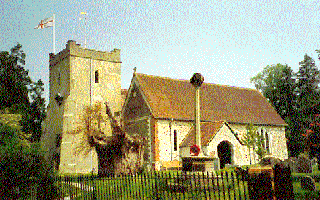
From Some Ancient Churches in North East Hampshire
Selborne lies below the tree-covered chalk escarpment called The Hanger,
meaning wooded slope. It is an ancient village, probably a settlement in
Saxon times, and is mentioned in the Domesday Book as Selesburna
(stream of the willows).
It is famous for its connection with Gilbert White, the naturalist, who was
born here in 1720 and died here in 1793. He spent most of his life living
at the Wakes, and was Curate here for many years, though never Vicar.
The church has a 13th century doorway with fine wrought iron hinges on the
original door. The nave of 1180 has sturdy Norman pillars and scalloped
capitals; the arches are Transitional Norman. The plain font is probably
Norman, though it may be Saxon.
In the chancel, also of 1180, the beautiful triptych forming the reredos
was painted in about 1515 and is attributed to the Flemish artist Jan
Mostaert. It depicts the Adoration of the Magi, with St Andrew and St
George on the panels. It was given by Gilbert White's brother Benjamin in
1793.
A large black tablet on the floor commemorates Gilbert White, Vicar of
Selborne 1681-1728, who was the famous Gilbert's grandfather. Also in the
chancel are two seats and a bench, made from old 15th century benches of
which the later Gilbert wrote: "At their ends they are ornamented with
carved blunt Gothic niches exactly correspondent to the arches of the
church and to a niche in the south wall."
In the north transept the window has English and Flemish 16th century glass.
Beside the vestry door is a piscina, indicating that an altar once stood to
the left. In the south aisle is the St Francis window installed in 1920 to
the memory of Gilbert White, as is the window in the east wall showing flora
and fauna and dedicated in 1993.
The church possesses a one-handed clock dating from 1678, possibly one of
the oldest in Hampshire.
The trunk of the great yew tree stands at the west end of the church, where
it grew for some 1400 years before being blown down in the great gale of
January 1990. Despite efforts to replant it, the tree has died, but a
cutting has been planted opposite the porch. On the side of the porch is a
tablet dedicated to the mortal remains found under the tree after it had
fallen.
From One Monday in November the story of the
Selborne and Headley workhouse riots of 1830
Selborne in 1830 . . .
Selborne was not a happy place during this period. William Cobbett, when
staying there overnight on one of his 'Rural Rides' in 1823, reported that
he met a local man who told him that "he did not believe there was a more
unhappy place in England" than Selborne. When asked why, he replied that
"there's always quarrels of some sort or other going on ... on matters of
rates and tithes mostly." Cobbett then remembered he had read about a shot
being fired through the vicar's window, and a King's proclamation for a
reward relating to the discovery of the perpetrator. Nobody came forward
to claim the reward.
The vicar in question, William Rust Cobbold, was not well loved in his
parish. He was regarded as arrogant by his parishioners, and on his own
admission seemed to be in constant conflict with his vestry. For a parish
which could still remember the gentle curacy of Gilbert White, this must
have been an unhappy situation indeed. We have records of acrimonious
notes passing between him and the officials of the parish, and of court
actions taken by him and them. Following the events of 1830 he acquired a
mastiff dog with a neck 'as thick as a lion's' for his protection; its
collar can be seen to this day in the church.
The vestry would meet in the public house, where they "knew the vicar would
not go", he claiming to be the "only gentleman in the village". It is
therefore perhaps not surprising to find that the ex-landlord of this pub,
who had been expelled from this position by Cobbold and who some sources
say was a member of the Selborne vestry, played a leading role in the events
which unfolded in the village and spilt over into neighbouring parishes.